
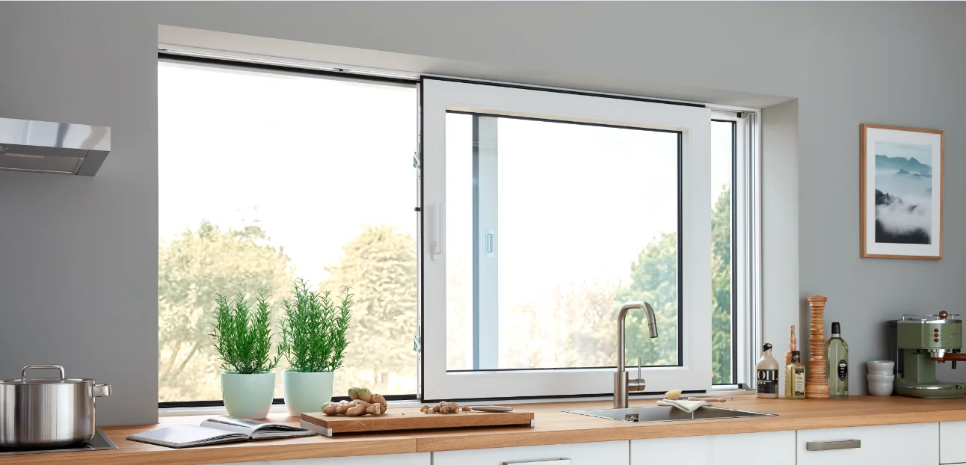
The mode of opening a window influences the usability of the surrounding area. An outward-opening sash window will occupy standing space on a small balcony, while an inward-opening window will interfere with furniture or walking space within a room. It is therefore critical to select a window which complements the space when designing a small house.
uPVC windows for balcony areas are particularly useful when the opening needs to provide ventilation without making the space around it difficult to use. Sliding windows move horizontally along the tracks, while tilt & turn windows offer controlled ventilation through their tilt function and open inward when a wider opening is needed. Inward-opening casement windows are yet another option when there is internal space for opening. This way, the window type could be chosen based on the available opening type rather than making homeowners work around an unsuitable opening mechanism.
How Sliding Windows Save Space in Compact Homes
Sliding uPVC windows will work well in houses where floor or outdoor space is limited. In sliding windows, the sashes slide on tracks horizontally, which means that there won’t be a need for the amount of space that inward- or outward-opening sashes would take. This makes the surrounding space easier to plan and use.
On a small balcony, the lack of an outward swing will create even more room to move about. In a smaller room, pieces of furniture can be positioned closer to the window without the obstruction of a swinging sash.
The space-saving advantages are:
- Clearer floor space: Furniture can remain closer to the window.
- No outward swing: The sash does not occupy balcony space when opened.
- Better use of narrow areas: Sliding configurations suit restricted clearances.
Keeping the Area Around the Window Usable
A window needs to add functionality without complicating the usability of the surroundings. This is especially true in smaller houses where there may not be enough space left between the window, furniture and walls.
Sliding windows ensure that the operation of the sashes is confined within the space of the window. As a result, homeowners can plan furniture and storage nearer to the window. Such uPVC windows for balcony offer a major advantage, as the sashes will not swing out to the balcony when opened.
Koemmerling’s tilt & turn windows offer flexibility for compact homes, allowing homeowners to manage ventilation according to the room’s needs. This makes them a practical option for bedrooms and other spaces where airflow needs to be adjusted throughout the day.

Choosing the Right uPVC Window Opening Style
Different compact rooms have different space limitations. For a balcony, a window is required which should not take up the floor space, and for a bedroom, there is a need for regulated ventilation without opening the complete sash.
uPVC windows come in various options like sliding, tilt and turn, and casement, allowing the opening style to match the room.
- Sliding windows: Suitable where inward and outward clearance is limited.
- Tilt & turn windows: Useful where controlled ventilation is important. The tilt position opens the top inward, while the full-turn position opens the sash inward.
- Inward-opening casement windows: Appropriate where sufficient internal space is available.
Furniture placement, access to balconies, ventilation requirements, and ease of cleaning must be taken into account prior to selecting a configuration.
Bringing Light and Ventilation Into Smaller Homes
Interior spaces that are small still require natural light and ventilation for them to be comfortable. Using the appropriate window operation ensures that residents can achieve both without increasing any space limitations.
Sliding windows offer natural lighting without the need for an opening arc. The tilt & turn windows give more versatility because of their dual functionality. The tilt mode enables the top of the sash to open inwards, thereby enabling controlled air circulation, while the complete inward opening allows more ventilation when needed.
This makes uPVC windows useful in smaller bedrooms, kitchens and studies where ventilation needs change throughout the day. The tilt position is especially practical when fresh air is needed without fully opening the sash.
Also Read: From Ventilation to Saving Space: How Koemmerling uPVC windows solve everyday problems
How Koemmerling’s uPVC Window Systems Fit Different Space Requirements
Koemmerling offers uPVC window systems designed around different opening requirements. Its sliding system uses horizontally moving sashes and is designed for space-economical operation. The system also includes an integrated removable bug screen and interlocks between panels that help seal against dust and pollutants. The sliding windows are slightly raised above the track for smoother movement and to help prevent dust from settling there.
Its tilt & turn system provides two operating modes: the top can tilt inward for ventilation, or the sash can open inward on its side hinges. The system also features a slope rebate for water drainage and locking keepers secured with steel reinforcement. Koemmerling’s casement system provides another option, with configurations that can open inward or outward and be tailor-made to required dimensions.
Conclusion
In case of space constraints, the method of operation of the window has a direct impact on the usage of the surrounding space. Sliding windows work well where there is a restriction in terms of clearance on the floor or balcony because of their horizontal operation of the sash. The tilt and turn windows work well because of their tilt operation and the ability to completely open inwardly.
The sliding, tilt & turn and casement systems by Koemmerling can be selected according to the layout and space needs of the room. Selecting the correct type of system helps retain usable space inside the room while enjoying natural light and ventilation.
Frequently Asked Questions (FAQs)
1. What is a uPVC window?
A uPVC window is a window made with uPVC profiles and available in different opening forms such as sliding, tilt & turn, and casement. The choice of configuration can depend on the layout of the room, ventilation, and clearance available.
2. Why are sliding uPVC windows suitable for small homes?
The sliding windows slide horizontally on tracks rather than swing either inwards or outwards. The space required around the window opening is reduced, and hence the windows are ideal for compact rooms and narrow balconies.
3. What type of uPVC window is best for a small room?
The best option depends on the layout. Sliding windows are perfect for places with limited clearances, whereas tilt & turn windows are best for places where ventilation holds major importance. Inward-opening casement windows are ideal for rooms that have adequate space inside.
4. What are the benefits of uPVC windows?
uPVC windows offer thermal and sound insulation, helping create a quieter, more comfortable indoor environment while keeping out draughts, dust and rain. They are also durable, weather-resistant, secure and easy to maintain, with design options to suit different spaces.
5. Is uPVC good for outdoor use?
Yes. uPVC window systems can be used for openings that lead to exterior areas like balconies, depending on the amount of clearance, exposure and ventilation that is required.